ESOPs
ESOP vs Phantom Stock for International Hires: Which Equity Structure Actually Works
97% of companies with multinational teams say they offer equity outside their headquarters country. But when a founder in Bengaluru hires an engineer in Berlin or a sales lead in Dubai, the ESOP vs Phantom Stock for international hires decision stops being theoretical and starts costing real time, real legal fees, and real compliance risk.
Key Takeaways
| Question | Short Answer |
|---|---|
| What's the core difference between ESOP and Phantom Stock? | ESOPs grant actual equity or the right to buy it. Phantom Stock pays cash pegged to share value, with no ownership transfer. |
| Which is easier for international hires? | Phantom Stock, because it avoids foreign securities filings, FEMA approvals, and local share registration. |
| Do international ESOP holders get the same tax treatment as domestic ones? | No. Perquisite tax under Section 17(2) applies differently across jurisdictions, and double taxation is a real risk without a treaty review. |
| Is Phantom Stock legally equity? | No. It is a cash-settled contractual right, not equity under the Companies Act 2013. |
| Can a company run both ESOP and Phantom Stock plans side by side? | Yes. Many Indian startups grant ESOPs domestically and Phantom Stock to international hires under one policy. |
| Where should ESOPs be tracked? | On a single system of record. See Tabulate's ESOP administration platform. |
| What happens to Phantom Stock when a company gets acquired? | Holders receive a cash payout tied to the deal price, settled through payroll, not a cap table entry. |
What ESOPs and Phantom Stock Actually Are for International Hires
An ESOP grants an employee the right to buy real shares at a fixed price after vesting. That employee becomes a shareholder. Their name sits on the cap table. Their equity is governed by the Companies Act 2013 and, for foreign nationals, by FEMA's cross-border share transfer rules.
Phantom Stock is different. It grants a contractual promise, not a share. The employee gets paid cash equal to the value of a hypothetical number of shares, usually at a liquidity event or on a fixed schedule.
No shares move. No foreign shareholder registration. No RBI reporting for inbound equity. That's the entire appeal.
Why International Equity Grants Get Complicated Fast
Grant an ESOP to an employee in the US, and you're now dealing with securities law in that state, potential 409A valuation requirements, and a foreign shareholder on an Indian cap table that MCA filings need to reflect.
Grant one to an employee in the UAE or Singapore, and FEMA's odi/fdi framework kicks in the moment shares cross the border.
None of this is optional paperwork. Every foreign shareholder triggers a filing. Every filing missed is a compliance gap that shows up at your next funding round's due diligence.
India is the only country in the top ten for multinational employee populations that doesn't rank in the top ten for discretionary equity awards. That gap exists because regulatory friction pushes companies toward cash-settled alternatives instead.
ESOP vs Phantom Stock for International Hires: The Core Differences
Here's the comparison that actually matters when you're deciding how to compensate someone outside India.
| Factor | ESOP | Phantom Stock |
|---|---|---|
| Ownership transferred | Yes, real shares | No, cash only |
| Cap table impact | Dilutive | None |
| Cross-border filing | FEMA, RBI reporting required | Generally none |
| Tax trigger | Exercise and sale, dual taxation risk | Payout date, treated as income |
| Governing law | Companies Act 2013, Section 62 | Contract law, employment agreement |
| Best suited for | Domestic and key leadership hires | International hires, contractors, high-friction jurisdictions |
Neither structure is universally better. But for a founder scaling across GCC, Southeast Asia, and the US, Phantom Stock removes friction that ESOPs simply weren't built to handle.
When ESOPs Work Best for International Hires
ESOPs still make sense for a founding international hire, a country head, or a senior leader you expect to stay for years.
Because real ownership signals real commitment. Employee owners at privately held firms had median tenures of 5.2 years, against 3.4 years for comparable non-owner employees. That's a 53% jump in retention, and it's the strongest argument for granting actual equity to the people who will define your company's next chapter.
If you're granting ESOPs to a US-based senior hire, budget for a 409A valuation alongside your Rule 11UA valuation back home. Two valuations, two compliance tracks, one cap table.
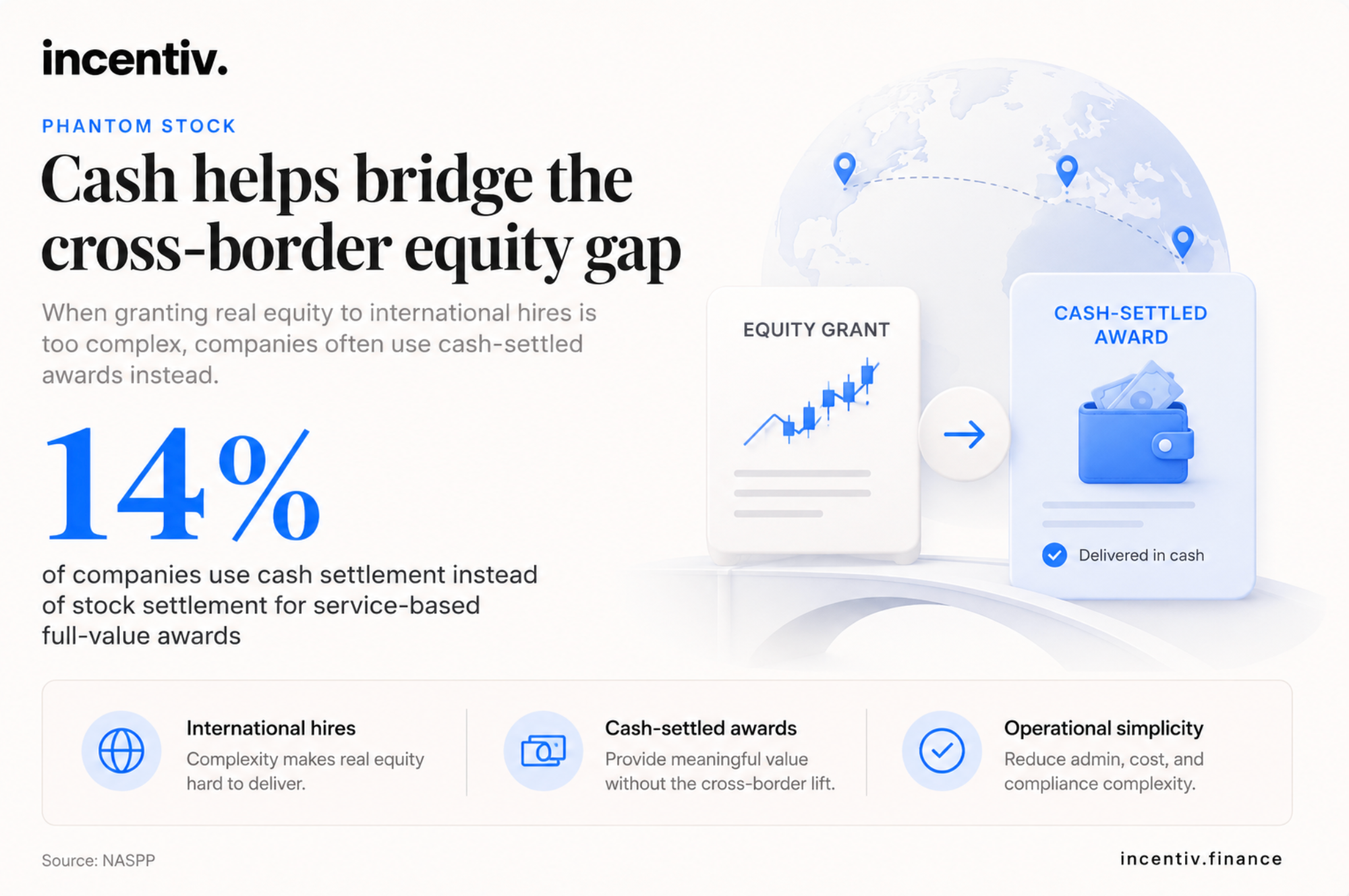
When granting actual stock to international hires is too complex, companies turn to cash-settled awards.
When Phantom Stock Is the Better Fit for International Hires
Phantom Stock earns its place for anyone outside your core leadership bench: regional sales hires, contractors, remote engineering teams spread across three time zones.
14% of companies already use cash settlement instead of stock for full value awards granted outside their headquarters country. That number will only grow as more Indian startups build distributed teams in 2026.
A Phantom Stock plan pays like equity, tracks like a bonus, and skips the FEMA filing entirely. For a 50-person distributed team, that's not a workaround. That's the correct structure.
Tax and Regulatory Considerations Across Borders
ESOP taxation for domestic employees is well trodden ground. Perquisite tax under Section 17(2) of the Income Tax Act applies at exercise, and capital gains apply at sale.
For an international hire, that same exercise event can trigger tax in their country of residence too, unless a treaty specifically addresses it. Double taxation is common, not rare.
Phantom Stock sidesteps the ownership question but not the tax question. The payout is treated as ordinary income in most jurisdictions, taxed through local payroll, no double-taxation puzzle to solve.
54% of companies adjust the size of their service-based full value awards based on local compensation levels or economic conditions. Founders granting Phantom Stock to a Dubai hire and an Indonesia hire on the same team should expect to localize the award value, not copy-paste the same number.
Comparison Table: ESOP vs Phantom Stock for International Hires by Scenario
| Hire Scenario | Recommended Structure | Why |
|---|---|---|
| Senior leader, expected 4+ year tenure | ESOP | Real ownership drives retention and alignment |
| Remote contractor, short-term engagement | Phantom Stock | No cap table entry, no foreign shareholder filing |
| Sales team across GCC and SEA | Phantom Stock | Localized cash payout, faster to administer |
| US subsidiary founding engineer | ESOP with 409A support | Long-term equity story matters for retention |
| Startup with no US or UAE entity yet | Phantom Stock | Avoids setting up foreign share registration prematurely |
Worked Example: What ₹40 Lakh in Grants Looks Like Either Way
Say a Bengaluru startup grants ₹40 lakh worth of equity value to a Dubai-based hire over four years.
As an ESOP: the employee gets options over shares worth ₹40 lakh at grant. FEMA filings are triggered at exercise, RBI reporting applies, and the company carries dilution on its cap table permanently.
As Phantom Stock: the employee is promised a cash payout equal to ₹40 lakh in value appreciation, paid at vesting milestones or exit, taxed as income, no dilution, no foreign filing.
Same economic value. Very different administrative load.
How Indian Startups Are Managing This Decision in 2026
Founders running mixed teams don't pick one structure and abandon the other. They run both, tracked in one place.
Companies designing an ESOP scheme for domestic leadership use cap table management built for real-time ownership tracking, so every option grant and every foreign shareholder entry stays accurate through funding rounds. And when it's time to convert Phantom Stock obligations or ESOP grants into an actual liquidity event, structured ESOP buyback programs handle the escrow, ROFR, and settlement mechanics without building that infrastructure from scratch.
CFOs and finance heads managing both cash-settled and equity-settled plans across three or four countries need one source of truth, not five spreadsheets. That's the entire premise behind Tabulate's equity management platform: cap table, ESOP administration, and ownership tracking in one workflow, built for founders who are done reconciling spreadsheet chaos every audit season.
Making the Right Call: ESOP vs Phantom Stock for International Hires in 2026
The decision comes down to three questions. How long do you expect this hire to stay. How much foreign filing burden can your finance team absorb. And how much dilution are you willing to carry for someone outside your core leadership.
Answer those honestly, and the ESOP vs Phantom Stock for international hires question stops being a legal debate and becomes a straightforward compensation design decision.
Run a quick calculation before committing to either structure using the ESOP calculator to see how dilution and vesting play out over four years.
Conclusion
ESOP vs Phantom Stock for international hires isn't a question with one right answer. It's a question with a right answer per hire.
Grant real equity to the people you're building the company around. Use Phantom Stock for everyone else on your global team. Track both on a single system, because a spreadsheet split across three currencies and two compliance frameworks is where compliance gaps start.
Frequently Asked Questions
Is Phantom Stock better than ESOP for international hires in 2026?
For most international hires, yes. Phantom Stock avoids FEMA filings and foreign shareholder registration, while ESOPs remain better suited to senior leaders you expect to retain long term.
Do international employees pay tax on ESOPs the same way as domestic employees?
No. International ESOP holders can face perquisite tax in India under Section 17(2) and separate income tax in their country of residence, creating a double taxation risk without a treaty review.
Can a startup offer both ESOP and Phantom Stock to different employees?
Yes, and many Indian startups do exactly this, granting ESOPs domestically and Phantom Stock to hires in the US, GCC, or Southeast Asia under one unified equity policy.
Does Phantom Stock show up on the cap table?
No. Phantom Stock is a cash-settled contractual right, not equity, so it never appears as a share class or dilutes existing shareholders.
What happens to an international ESOP holder's shares if the company is acquired?
Their vested options convert into cash or acquirer shares per the deal terms, subject to the same FEMA and RBI reporting that applied when the shares were originally issued.
Which is cheaper to administer, ESOP or Phantom Stock, for a distributed team?
Phantom Stock is generally cheaper to administer for international hires because it skips foreign securities filings, share registration, and RBI reporting that ESOPs require.
Should an early-stage Indian startup worry about ESOP vs Phantom Stock for international hires before hiring abroad?
Yes. Deciding the structure before the first international offer letter goes out saves months of compliance cleanup later, especially once foreign shareholders start appearing on the cap table.
Next Step
See how Incentiv can help
Infrastructure for cap tables, ESOP management, and secondary markets in India's private markets.