ESOPs vs RSUs: The Complete India Guide for Employees and Founders (2026)
ESOPs give you the right to purchase shares at a fixed price after vesting. You must pay the exercise price to convert options into shares. RSUs, by contrast, promise to deliver shares automatically upon vesting with no purchase required. In India, ESOPs are taxed at exercise, while RSUs are taxed at vesting. This timing difference creates distinct cash flow pressures, especially for employees at private companies where shares cannot yet be sold.
The choice between the two typically reflects company stage and cash position. Indian startups favor ESOPs to conserve cash, while listed companies and late-stage firms lean toward RSUs for their simplicity. For employees, understanding taxation, liquidity requirements, and upside potential is critical to evaluating your true compensation.
Key Highlights:
- ESOPs require you to pay a strike price to acquire shares, while RSUs are granted free of cost at vesting.
- Indian tax law treats both as salary income (perquisite tax) at the triggering event, then again as capital gains at sale.
- ESOP perquisite tax can be deferred for up to 5 years if your company qualifies under Section 80-IAC (DPIIT-recognized startups), but RSUs have no equivalent deferral.
- In a high-growth startup, ESOPs with a low strike price generate far more wealth than RSUs granted at today's FMV.
- RSUs create immediate tax liability at vesting with no cash inflow for private company employees, potentially requiring you to sell shares just to cover the tax.
- Both instruments vest over 4 years typically, but ESOPs give you the choice whether to exercise, while RSUs vest automatically.
What Are ESOPs?
An Employee Stock Option Plan (ESOP) grants you the right to purchase company shares at a predetermined price (the strike price or exercise price) after completing a vesting period. You are not obligated to exercise. If the current market value is below your strike price, you simply let the options lapse.
How do ESOPs works:
You receive a grant of 10,000 options at a strike price of ₹100 per share. The company sets a 4-year vesting schedule with a 1-year cliff. After 1 year, 25% vest. The remaining 75% vest monthly over the next 3 years.
At year 3, you have 7,500 vested options. The company's Fair Market Value (FMV) is now ₹500 per share. You decide to exercise. You pay ₹7.5 lakh (7,500 shares × ₹100) as the exercise price. The perquisite value is ₹30 lakh (₹500 FMV - ₹100 strike price × 7,500 shares). You owe perquisite tax of roughly ₹9 lakh (at 30% tax slab). Total cash outlay: ₹16.5 lakh. In return, you receive 7,500 shares worth ₹37.5 lakh on paper.
If you later sell those shares at ₹800, you pay capital gains tax on the ₹22.5 lakh profit (₹800 sale price - ₹500 FMV at exercise × 7,500 shares).
Why companies use ESOPs:
Startups with limited cash use ESOPs to attract talent without upfront salary costs. The strike price is often set at face value (₹1 or ₹10) or a deep discount to FMV, creating significant upside if the company grows.
ESOPs align employee incentives with company performance. If the valuation stagnates or declines, employees don't lose money because they simply don't exercise. This downside protection is the key difference from RSUs.
What Are RSUs?
A Restricted Stock Unit is a promise to deliver a specific number of company shares upon vesting. No purchase is required. Once vesting conditions are met (typically time-based), the shares are automatically transferred to your demat account.
How do RSUs work:
You receive a grant of 1,000 RSUs with a 4-year vesting schedule and 1-year cliff. At the end of year 1, 250 RSUs vest. The FMV on that date is ₹500 per share. The company transfers 250 shares to your account (worth ₹1.25 lakh). This amount is treated as perquisite income. You owe approximately ₹37,500 in tax (at 30% slab), even though you received shares, not cash.
If you don't have cash to pay the tax, you must sell shares immediately. Many companies handle this via "sell-to-cover," where the employer sells a portion of your shares to cover the TDS liability before delivering the rest.
At year 2, another 250 vest at ₹600 FMV. You owe tax on ₹1.5 lakh. And so on.
When you eventually sell, you pay capital gains tax on the difference between sale price and the FMV at each vesting date. If you sell the first batch of 250 shares at ₹800, your taxable capital gain is ₹75,000 (₹800 - ₹500 × 250 shares).
Why do companies use RSUs:
RSUs are simpler for employees to understand. There's no exercise decision, no strike price, no cash outlay beyond taxes. The employee automatically becomes a shareholder.
Listed companies and late-stage firms with stronger balance sheets prefer RSUs because they deliver immediate value and avoid the optics of employees "not exercising" their options. However, RSUs are rare in early-stage Indian startups because of immediate tax liability without liquidity.
ESOP vs RSU: Key Differences
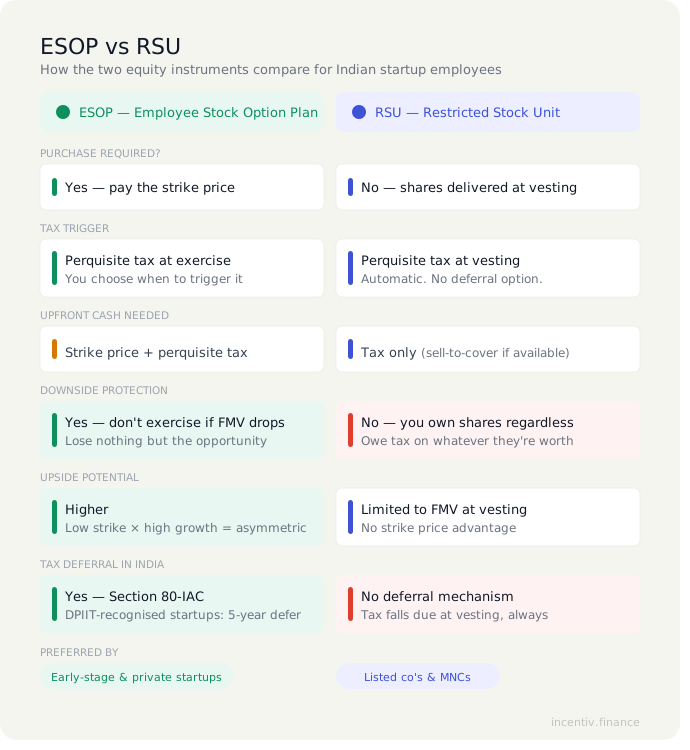
Taxation of ESOPs in India
ESOP taxation happens in two stages:
Stage 1: Perquisite tax at exercise
The difference between FMV and strike price is treated as salary income. Taxed at your slab rate (up to 30% + cess + surcharge). Your employer must deduct TDS. This tax is payable in the year of exercise, even if you haven't sold the shares.
Example: You exercise 5,000 options at ₹50 strike price. FMV on exercise date is ₹400. Perquisite = (₹400 - ₹50) × 5,000 = ₹17.5 lakh. Tax at 30% = ₹5.25 lakh. Total cash needed: ₹2.5 lakh (exercise) + ₹5.25 lakh (tax) = ₹7.75 lakh.
Section 80-IAC deferral:
If your company is a DPIIT-recognized startup and meets all eligibility criteria under Section 80-IAC, you can defer perquisite tax for up to 5 years from the date of exercise, or until you leave the company, or until shares are sold, whichever is earlier. This deferral does not apply to RSUs.
Stage 2: Capital gains tax at sale
When you sell shares acquired through ESOPs, you owe capital gains tax on the profit. The holding period starts from the exercise date (not grant or vesting date). Your cost basis is the FMV on the exercise date.
For unlisted shares (most startups):
- Held less than 24 months: Short-term capital gains (STCG), taxed at your slab rate.
- Held 24 months or more: Long-term capital gains (LTCG), taxed at 12.5% with no indexation. Exemption on first ₹1.25 lakh per year.
For listed shares:
- Held less than 12 months: STCG at 20%.
- Held 12 months or more: LTCG at 12.5%, exemption on first ₹1.25 lakh per year.
Taxation of RSUs in India
RSUs are also taxed in two stages, but the timing and mechanics differ:
Stage 1: Perquisite tax at vesting
The full FMV of vested shares is treated as salary income on the vesting date. You owe tax at your slab rate, and your employer deducts TDS before delivering shares (or via sell-to-cover).
Example: 500 RSUs vest when FMV is ₹600. Perquisite = ₹3 lakh. Tax at 30% = ₹90,000. If your employer doesn't facilitate sell-to-cover, you owe ₹90,000 in cash even though you received shares, not money. This is the cash flow trap for employees at private companies with no liquidity.
No Section 80-IAC deferral. RSUs do not qualify for startup tax deferral under Section 80-IAC. Tax is due immediately upon vesting.
Stage 2: Capital gains tax at sale
When you sell RSU shares, capital gains tax applies to the difference between sale price and the FMV at vesting (which was already taxed as salary income). Holding period rules are identical to ESOPs.
For foreign RSUs (common at Indian MNCs with US parent companies):
If you hold RSUs in a NASDAQ-listed company, the vesting event creates Indian tax liability. If the US employer also withholds taxes, you can claim Foreign Tax Credit (FTC) under the India-US DTAA by filing Form 67 before your ITR deadline. Failing to claim FTC results in double taxation. RSUs from foreign companies must also be disclosed in Schedule FA of your ITR.
Cash Flow Comparison: ESOP vs RSU
The most overlooked difference between ESOPs and RSUs is the cash flow timing.
ESOP scenario:
You have 10,000 vested options. Strike price ₹50, FMV ₹300. You need ₹5 lakh (exercise price) + ₹7.5 lakh (perquisite tax at 30%) = ₹12.5 lakh upfront. You can defer exercise until you have cash or until liquidity is available. If the company never provides liquidity, you may never exercise and incur zero tax.
RSU scenario:
You have 1,000 RSUs vesting annually at ₹300 FMV. Each year, ₹3 lakh in shares vest. You owe ₹90,000 in tax. You cannot defer vesting. If you're at a private company with no liquidity, you must pay ₹90,000 out of pocket every year just to receive shares you cannot sell. Over 4 years, that's ₹3.6 lakh in taxes on ₹12 lakh worth of illiquid shares.
This is why RSUs are uncommon at Indian startups. The tax liability without liquidity creates real financial hardship for employees.
When to Choose ESOPs vs RSUs (For Founders)
Use ESOPs if:
You're an early-stage startup (pre-Series B) with limited cash and high growth potential. You want employees to share in upside without immediate dilution or tax burden. You're a DPIIT-recognized startup and can offer Section 80-IAC tax deferral. Your employees understand equity compensation and can tolerate the complexity of strike prices and exercise windows.
Use RSUs if:
You're a listed company or late-stage startup with stable valuations. You want simplicity and immediate employee ownership. You can facilitate liquidity (sell-to-cover) to handle tax obligations. Your employee base expects straightforward equity grants with no purchase requirements.
Hybrid approach:
Some companies grant ESOPs to early employees (when valuations are low) and switch to RSUs post-Series C or IPO. This preserves upside for early hires while simplifying equity grants as the company matures. Carta research shows startups switch to RSUs on average 5.5 years after founding and at $1 billion post-money valuation.
Real Wealth Creation: ESOP vs RSU in Practice
The difference between ESOPs and RSUs becomes stark in high-growth scenarios.
Scenario: Early employee at a Series A startup
Grant date: Company valued at ₹100 crore. You join as employee #25.
ESOP grant: 10,000 options, strike price ₹10 (face value).
RSU grant: 1,000 RSUs at ₹300 FMV.
Four years later: Company reaches Series C at ₹1,500 crore valuation (15x growth). FMV per share is ₹4,500.
ESOP outcome:
You exercise all 10,000 options. Exercise cost: ₹1 lakh. Perquisite: (₹4,500 - ₹10) × 10,000 = ₹4.49 crore. Tax: ₹1.35 crore. Total shares acquired: 10,000, worth ₹4.5 crore.
RSU outcome:
You received 1,000 shares over 4 years at varying FMVs (₹300, ₹800, ₹1,500, ₹3,000 on average = ₹1,400). Cumulative perquisite taxed: ₹14 lakh. Total shares acquired: 1,000, worth ₹45 lakh.
Wealth gap: ₹4.05 crore.
In this scenario, the ESOP holder's low strike price generated 10x more wealth than the RSU holder, even after accounting for higher perquisite tax. This is why ESOPs dominate early-stage equity compensation in India.
What Employees Should Ask Before Accepting Equity Compensation
For ESOPs:
- What is my strike price, and how does it compare to today's FMV?
- What is the vesting schedule and cliff?
- If I leave, how long do I have to exercise vested options? (30 days, 90 days, or longer?)
- Does the company qualify for Section 80-IAC tax deferral?
- Will the company facilitate liquidity (buybacks, secondary sales) before an exit?
- What is the company's repurchase policy if I leave?
For RSUs:
- What is the vesting schedule?
- Will the company facilitate sell-to-cover for TDS?
- If the shares are illiquid (private company), how do I pay perquisite tax every year without selling?
- Are these domestic RSUs or foreign RSUs? (Foreign RSUs require Schedule FA disclosure and FTC claims.)
- What is the company's track record on liquidity for RSU holders?
Managing Your ESOP and RSU Portfolio
If you hold both ESOPs and RSUs (common at late-stage companies that switched equity structures), you need to track:
Vesting schedules: When do options and RSUs vest?
Exercise windows: How long do you have to exercise vested options if you leave?
Tax obligations: When do perquisite tax events occur? Do you have cash to cover them?
Capital gains holding periods: When did each batch of shares enter your demat account? Holding from that date determines LTCG vs STCG.
Liquidity opportunities: When can you sell shares? Company buybacks, secondary platforms, or IPO?
If you're managing multiple grants across years, cap table software like Tabulate can consolidate everything in one dashboard.
How Incentiv Helps Companies Manage ESOPs and RSUs
Whether you're designing your first ESOP plan, switching from ESOPs to RSUs, or managing equity for 500+ employees, Incentiv's Tabulate platform automates the entire lifecycle.
Tabulate handles grant letters, vesting schedules, exercise tracking, automated employee notifications, FMV calculations, waterfall modeling, and cap table updates. For founders and CFOs, Tabulate reduces ESOP admin work by 90% while ensuring 100% compliance with Companies Act 2013, Income Tax Act, and SEBI regulations.
For companies managing secondary transactions (employee liquidity, buybacks), Incentiv's Secondary Platform connects sellers with institutional buyers, handles all documentation (NDA, LOI, SPA), and ensures FEMA/SEBI compliance throughout.
FAQs
Can ESOPs be converted to RSUs?
No. ESOPs and RSUs are distinct instruments. However, companies can replace an ESOP plan with an RSU plan going forward. Existing ESOP grants remain governed by their original terms. Employees with unvested ESOPs at the time of the switch may receive new RSU grants, but vested ESOPs must still be exercised under the original terms.
Which is better for employees: ESOP or RSU?
It depends on company stage and your financial situation. ESOPs offer higher upside in high-growth startups due to low strike prices, but require significant cash to exercise. RSUs are simpler and deliver shares automatically, but create tax liabilities without liquidity at private companies. For early-stage startup employees, ESOPs with Section 80-IAC deferral are usually better. For employees at listed companies or late-stage firms, RSUs are safer and more predictable.
Do RSUs qualify for Section 80-IAC tax deferral in India?
No. Section 80-IAC applies only to ESOPs, not RSUs. RSU holders at DPIIT-recognized startups must pay perquisite tax immediately upon vesting, regardless of whether shares are liquid.
What happens to unvested ESOPs and RSUs if I resign?
Unvested ESOPs and RSUs typically lapse when you leave the company. Vested ESOPs must usually be exercised within 30 to 90 days of resignation (check your grant agreement). Vested RSUs remain in your demat account and are yours to keep. Some companies have different treatment for "good leavers" versus "bad leavers" or may offer extended exercise windows for long-tenured employees.
Are ESOPs and RSUs reported differently in my ITR?
Both are reported as salary income (perquisites) in the year the taxable event occurs. ESOPs are taxed at exercise, RSUs at vesting. Your employer issues Form 16 reflecting the perquisite value and TDS deducted. When you sell shares, you report capital gains under the appropriate schedule based on holding period (STCG or LTCG) and whether shares are listed or unlisted.
Can I hold both ESOPs and RSUs from the same company?
Yes. Companies that switch from ESOPs to RSUs often have employees with both. Each grant is tracked separately. ESOPs have their own strike price, vesting schedule, and exercise windows. RSUs vest independently and deliver shares automatically. You must track tax obligations and holding periods for each instrument separately.
Conclusion
ESOPs and RSUs represent two fundamentally different approaches to employee ownership. ESOPs bet on growth and reward early believers with asymmetric upside. RSUs deliver certainty and immediate ownership at the cost of capped returns.
For employees, the critical question is not which instrument is "better" in the abstract, but which aligns with your company's stage, your cash position, and your risk tolerance. A low-strike-price ESOP at a Series A startup can generate life-changing wealth. An RSU at a stable listed company delivers predictable value with far less execution risk.
The real trap is not understanding what you hold. Too many employees discover only at exit that their "equity package" required ₹20 lakh in cash to exercise, or that their RSUs triggered ₹5 lakh in taxes over four years with no way to sell the shares. Read your grant agreements. Ask the right questions. And if your company doesn't provide clear answers, that's a signal worth paying attention to.